What is Order Fulfilment? The Complete Guide for Australian eCommerce
This guide will walk you through the entire order fulfilment process, from receiving stock to shipping, and help you discover the best strategy for your Australian business.
3PL GUIDEECOMMERCE FULFILLMENT
Pik Pak Digital
12/27/20257 min read
What is Order Fulfilment? The Complete Guide for Australian eCommerce
As an eCommerce business owner, you know the thrill of seeing a new order notification. But what happens next can make or break your brand.
The entire process of getting that product from your shelf into your customer's hands is called order fulfilment. It’s the engine room of your business, and getting it right is the key to scaling your operations and winning back your valuable time.
This guide will walk you through the entire order fulfilment process, from receiving stock to shipping, and help you discover the best strategy for your Australian business.
What is Order Fulfilment? (And Why It's More Than Just Packing Boxes)
In simple terms, order fulfilment covers everything that happens after a customer clicks 'buy' on your website. It’s the physical journey your product takes to reach its destination.
While it might seem like just putting items in a box, it's the backbone of your customer experience and a direct reflection of your brand's reliability.
A smooth, fast, and accurate fulfilment process leads to happy, loyal customers who leave positive reviews and buy from you again. On the other hand, poor fulfilment, late deliveries, wrong items, or damaged goods - costs you time, money, and your hard-earned reputation.
The 5 Core Steps of the Order Fulfilment Process
The fulfilment journey can be broken down into five clear, essential steps.
Imagine it as a well-oiled machine, where each part must function perfectly for a seamless delivery.
Step 1: Receiving Inventory - This is the beginning of the process. Your products arrive at the warehouse or storage location. They are carefully inspected, counted, and entered into an inventory management system so you always know exactly what you have in stock.
Step 2: Warehousing & Storage - Once received, your items are safely stored and organised. A good system ensures products are easy to find, protected from damage, and ready for when an order comes in.
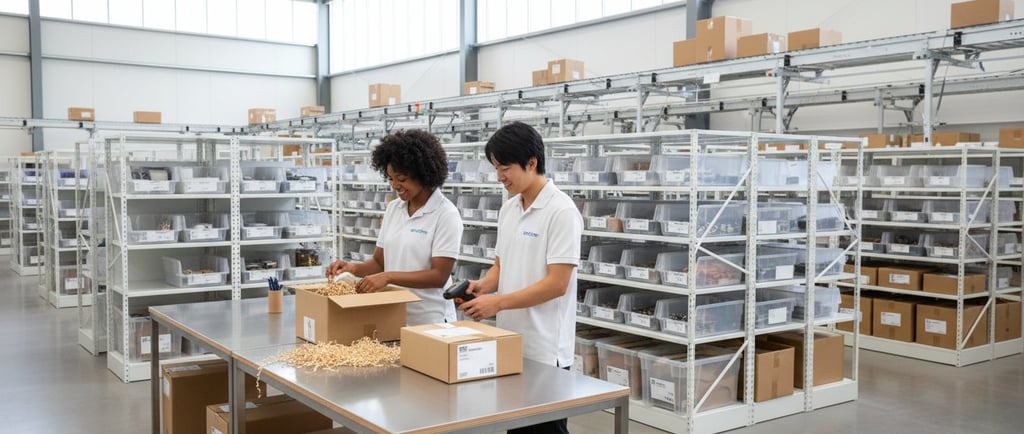
Step 3: Picking & Packing - When a customer places an order, the 'pick and pack' process begins. The correct items are 'picked' from their storage locations. Then, they are securely 'packed' into the right-sized box with appropriate packaging materials to ensure they arrive in perfect condition.
Step 4: Shipping - The packed order is labelled, and a courier is assigned to deliver it. This step involves generating shipping labels, tracking numbers, and handing the package over to the shipping carrier for its final journey to the customer's doorstep.
Step 5: Returns Management - Sometimes, customers need to return an item. This process, also known as reverse logistics, involves receiving the returned product, inspecting it, updating inventory, and processing a refund or exchange for the customer.
Choosing Your Fulfilment Strategy: The 3 Main Models
There is no one-size-fits-all solution for order fulfilment.
The best method depends on your business's size, order volume, and long-term goals. Let's compare the pros and cons of the three most popular models.
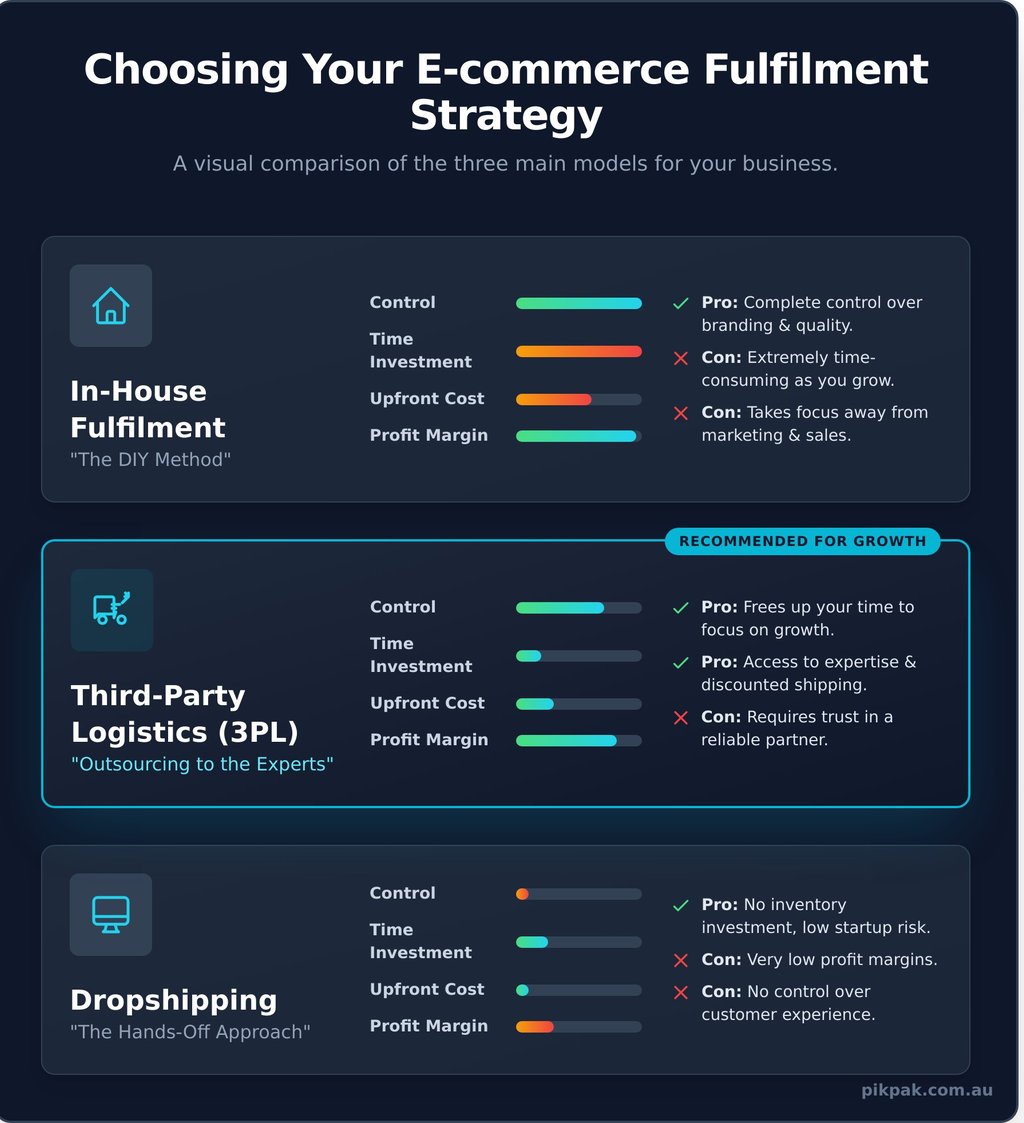
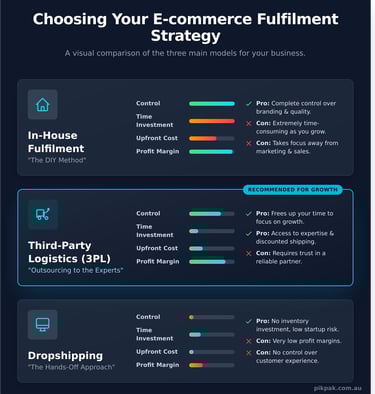
In-House Fulfilment: The DIY Method
This is where most businesses start.
You manage everything yourself from a spare room, a garage, or your own small warehouse. You are in charge of storing inventory, packing boxes, and taking them to the post office.
Pro: You have complete control over your branding, packaging, and quality checks. It can be cost-effective when you're just starting out.
Con: It is incredibly time-consuming and becomes overwhelming as your business grows. Packing boxes takes you away from focusing on marketing, product development, and sales.
Third-Party Logistics (3PL): Outsourcing to the Experts
In this model, you partner with a specialised company that handles the entire fulfilment process for you.
A 3PL provider stores your inventory in their professional warehouse and manages the picking, packing, and shipping of all your orders.
Pro: It frees up your time instantly and gives you access to professional expertise and discounted shipping rates you couldn't get on your own. It allows you to scale your business without needing more physical space.
Con: It requires placing trust in a partner and ensuring you have clear communication. Finding the right 3PL is crucial. If you're ready to scale, see how Pik Pak's 3PL services can help you grow.
Dropshipping: The Hands-Off Approach
With dropshipping, you never physically touch or store the product. When a customer places an order, you forward it to the manufacturer or supplier, who then ships the product directly to the customer.
Pro: There is no need to invest in or store inventory, which means lower startup costs and less risk.
Con: You have much lower profit margins and almost no control over the shipping times, packaging, or overall customer experience, which can damage your brand.
5 Signs You've Outgrown In-House Fulfilment
How do you know when the 'garage' phase is over and it's time to outsource?
If you find yourself nodding along to this checklist, it's a strong sign that it's time to partner with a 3PL.
You spend more of your day packing orders than you do on marketing, sales, or strategy.
Your home, office, or storage unit is overflowing with inventory, and you're constantly running out of space.
Shipping errors, like sending the wrong item or delays, are becoming more frequent and leading to customer complaints.
You can't keep up with order volume during peak seasons like Christmas or Black Friday, leading to a backlog.
You're missing out on family dinners or personal time because you're stuck packing boxes late into the night.
How to Choose the Right Fulfilment Partner
Not all 3PLs are created equal, especially in the unique Australian market. Here’s what you should look for to find a partner that will help your business thrive.
Technology & Integration
A great 3PL partner should feel like an extension of your team.
Does their system connect easily and automatically with your eCommerce platform, like Shopify, WooCommerce, or BigCommerce?
You need a partner that provides a real-time view of your inventory levels and allows you to track order status effortlessly.
Location & Shipping Network
For an Australian business, warehouse location is key. A centrally located fulfilment centre can help you reach customers across the country more quickly and affordably.
The right partner will also have strong relationships with multiple couriers, ensuring you always get the best possible shipping rates and service.
Pricing & Transparency
Your partner's pricing model should be clear, simple, and easy to understand.
Look for a pay-as-you-go structure that allows you to scale up or down without penalty.
Be wary of providers who have complex fee structures, hidden costs, or demand long-term, lock-in contracts.
Pik Pak: Fulfilment Made Easy for Australian Businesses
At Pik Pak, we believe fulfilment shouldn't be a headache.
Our powerful, web-based platform gives you full visibility and control over your logistics without the complexity. We automate the entire process, from inventory management to shipping, so you can finally stop packing boxes and get back to focusing on what you do best: growing your business.
With no setup fees, no software to install, and no lock-in contracts, we make professional fulfilment accessible for everyone. Get a transparent quote and see how simple scaling your business can be.
Frequently Asked Questions About Order Fulfilment
What is the difference between a fulfilment centre and a warehouse?
A warehouse is simply a large building used for storing goods.
A fulfilment centre, on the other hand, is an active hub where orders are received, processed, picked, packed, and shipped.
It's a warehouse that offers end-to-end logistics services.
How much does order fulfilment cost in Australia?
Costs vary based on your order volume, the size and weight of your products, and the specific services you need. 3PLs typically charge for receiving inventory, storage (per pallet or bin), and a pick-and-pack fee for each order processed.
What is a 3PL and what do they do?
A 3PL, or Third-Party Logistics provider, is a company you can outsource your logistics operations to.
They handle everything from warehousing and inventory management to order fulfilment and shipping on behalf of your eCommerce business.
Can a small business benefit from using a fulfilment service?
Absolutely. In fact, small businesses often benefit the most.
Outsourcing allows them to offer fast, professional shipping that competes with larger brands, all while freeing up the owner's time to focus on growth activities instead of manual labour.
What's the difference between order fulfilment and dropshipping?
With order fulfilment (using a 3PL), you own the inventory; your 3PL partner just stores and ships it for you.
With dropshipping, you never own the inventory, the manufacturer or another retailer ships it on your behalf.
How does Pik Pak connect to my online store?
Pik Pak offers seamless, pre-built integrations with all major eCommerce platforms.
Connecting your store is a simple point-and-click process that requires no technical expertise, allowing your orders to flow into our system automatically.
If you're tired of being buried in bubble wrap and packing tape, it's time to consider a smarter way to run your business.
Outsourcing your order fulfilment isn't just about shipping products; it's about reclaiming your time, improving your customer experience, and building a scalable foundation for future growth.
Let an expert handle the logistics so you can focus on your passion.
Stop packing boxes. Get a free quote from Pik Pak today!
References
1. Australia Post Business Solutions - https://auspost.com.au/business
2. Australian Order Fulfillment Services - https://australianorderfulfillment.com
3. Shopify Australia Ecommerce Guide - https://www.shopify.com.au/blog/ecommerce-fulfillment
4. What is Order Fulfillment - Complete Guide - https://www.ecommercefulfilment.com/resources/ecommerce-insights/what-is-order-fulfilment
5. BigCommerce Order Fulfillment Strategies - https://www.bigcommerce.com.au/articles/ecommerce/order-fulfillment
6. WooCommerce Shipping Solutions Australia - https://woocommerce.com/shipping-solutions-australia
7. Australian 3PL Industry Standards - https://www.freightandtrade.com.au/industry-insights
8. StarTrack Business Shipping Services - https://startrack.com.au/business
9. Sendle Small Business Shipping Guide - https://www.sendle.com/en-au/resources
10. Australian Bureau of Statistics Retail Trade - https://www.abs.gov.au/statistics/industry/retail-and-wholesale-trade
11. CSG 3PL Order Fulfillment Guide - https://csg3pl.com.au/blog/order-fulfilment-services-101-a-guide-for-australian-startups
12. The Complete Guide to Ecommerce Order Fulfillment - https://mwfulfilment.com/the-complete-guide-to-ecommerce-order-fulfilment-processes
13. ShipBob Order Fulfillment Process Guide - https://www.shipbob.com/blog/order-fulfillment
14. Retalon Order Fulfillment Process 2025 - https://retalon.com/blog/order-fulfillment-process
15. SmartOSC eCommerce Fulfillment Strategy - https://www.smartosc.com/ecommerce-fulfillment-strategy-key-benefits-for-australian-businesses
Contact us
Useful Links
Established in 2007, Pik Pak specialises in warehousing and order fulfilment services designed specifically for online stores and eCommerce brands.
(c) 2025 All rights reserved.
Pik Pak Logistics Pty Ltd, ABN: 81 130 329 912
Our Partners