What is Logistics? A Simple Guide for Growing Businesses
This guide will break down the key parts of logistics and show you how to turn them from a business headache into your greatest competitive advantage.
3PL GUIDEECOMMERCE FULFILLMENT
Pik Pak Digital
12/17/20255 min read
As your business grows, you quickly learn that selling a product is only half the battle.
The other half? Getting that product into your customer’s hands quickly, accurately, and affordably. This entire process is called logistics. For many business owners, it can feel like a complex and overwhelming challenge. But it doesn’t have to be.
This guide will break down the key parts of logistics and show you how to turn them from a business headache into your greatest competitive advantage.
What is Logistics? A Simple Definition
At its core, logistics is the detailed process of managing how resources are acquired, stored, and transported to their final destination. In simple terms for an eCommerce business, logistics is how your products get from your warehouse shelf (point A) to your customer’s doorstep (point B).
It’s the engine that powers your online store, working behind the scenes to make sure every order is a success. It’s much more than just shipping; it’s the entire end-to-end journey of your inventory.
The Core Components of Business Logistics
Logistics can be broken down into five essential activities. Understanding each one helps you see how they work together to create a seamless customer experience.
Inventory Management: This is about knowing what you have, where it is, and how much you need. It involves tracking stock levels to prevent overselling and ensuring products are stored safely and can be found easily.
Warehousing: This refers to the physical space where your products are stored. A good warehouse is organised, secure, and optimised for efficiently finding and moving products.
Order Fulfilment: This is the 'pick, pack, and ship' process. When a customer places an order, fulfilment is the action of locating the item in the warehouse (picking), preparing it for shipment (packing), and getting it ready for the courier.
Transportation: This is the part most people think of—moving the packed order from your warehouse to the customer. It involves choosing the right shipping carriers and methods to ensure timely and cost-effective delivery.
Reverse Logistics: Sometimes, customers need to send products back. Reverse logistics is the process of managing these returns smoothly, from receiving the item back to restocking it or processing a refund.
Logistics vs. Supply Chain: What's the Difference?
You’ll often hear the terms 'logistics' and 'supply chain' used together, but they aren’t the same thing. Think of the supply chain as the entire journey of a product from start to finish, including sourcing raw materials, manufacturing, and final delivery.
Logistics is one crucial part of that bigger supply chain, focused specifically on the movement and storage of finished goods.
Why Good Logistics is Crucial for eCommerce Success
You can have the best product and the most brilliant marketing, but poor logistics can stop a great business from growing. How you manage the fulfilment process directly impacts your customer satisfaction, your operational costs, and your ability to scale.
Meet and Exceed Customer Expectations
In today's competitive market, customers expect fast and reliable shipping. A smooth logistics process builds trust and loyalty. Accurate orders prevent the frustration of receiving the wrong item, while an easy returns process can turn a potentially negative experience into a positive one, encouraging repeat business.
Improve Your Efficiency and Save Money
Time is money. Optimised logistics processes reduce wasted time, materials, and effort. By partnering with logistics experts, you can often access bulk shipping rates that are far cheaper than what you could get on your own. Most importantly, it allows you to avoid the high overhead costs of leasing your own warehouse, hiring staff, and buying equipment.
Create a Foundation for Scalable Growth
You can't scale a thriving business from your garage or living room forever. As order volumes increase, a solid logistics plan is essential to keep up with demand without sacrificing quality.
It allows you to focus your valuable time on what you do best, marketing, product development, and growing your brand. While an expert handles the complexities of fulfilment.
Feeling overwhelmed? Let Pik Pak handle the hard work.
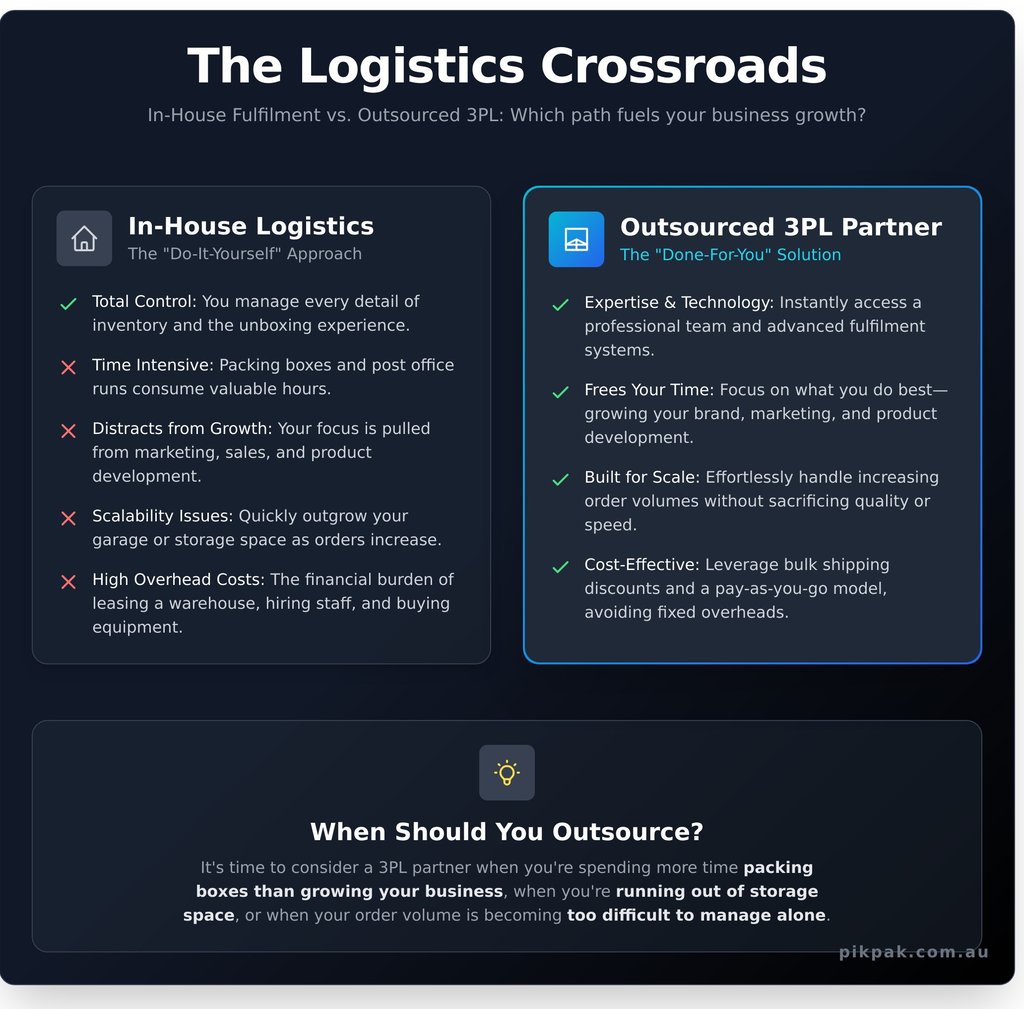
In-House vs. Outsourced Logistics (3PL): The Smart Choice
Every growing eCommerce business eventually faces a critical decision: should you continue to manage logistics yourself, or is it time to outsource? The right choice depends on your order volume, resources, and long-term goals.
Managing Logistics In-House
Handling your own logistics is the natural starting point for most businesses. It gives you complete, hands-on control over your inventory and the unboxing experience. However, as your business grows, packing boxes and running to the post office quickly becomes a major time-sink that distracts you from strategic activities.
Partnering with a 3PL (Third-Party Logistics)
A 3PL (Third-Party Logistics) company is a partner that handles your entire fulfilment process for you. You ship your inventory to their warehouse, and when an order comes in through your online store, they pick, pack, and ship it directly to your customer. This gives you instant access to expert staff, advanced technology, and a scalable infrastructure. With a pay-as-you-go model, you only pay for the warehouse space and services you actually use, making it a flexible and cost-effective solution. This is the secret to scaling without the headache. See how a 3PL can transform your business. Get a quote today.
Frequently Asked Questions
What are the main functions of logistics?
The main functions include inventory management (tracking stock), warehousing (storage), order fulfilment (picking and packing), transportation (shipping), and reverse logistics (handling returns).
What is an example of logistics?
A great example is when you order a product online. The process of that product being located in a large warehouse, placed in a box, labelled, and then shipped by a courier to your front door is all part of logistics.
Why is logistics so important for a business?
Logistics is vital because it directly impacts customer satisfaction, operational costs, and a company's ability to grow. Efficient logistics leads to happy customers, lower expenses, and a brand that can be trusted to deliver.
What is a 3PL and how does it work?
A 3PL (Third-Party Logistics) is a company you hire to manage your warehousing and shipping. You send your products to their fulfilment centre, and they handle the rest—storing your inventory and shipping orders directly to your customers as they come in.
At what point should I outsource my logistics?
You should consider outsourcing when you find yourself spending more time packing boxes than on growing your business, when you're running out of storage space, or when your order volume is becoming too difficult to manage on your own.
Can a 3PL help me save money on shipping?
Yes, absolutely. 3PL providers ship thousands of parcels every day and have access to bulk shipping discounts from major carriers. They pass these savings on to their clients, often resulting in significantly lower shipping costs.
Logistics doesn't have to be a barrier to your success. By understanding the fundamentals and knowing when to ask for help, you can create a streamlined, efficient system that delights your customers and powers your growth. Stop letting packing and shipping dictate your schedule and start focusing on the future of your brand. Ready to simplify your logistics?
Talk to a Pik Pak expert today.
References
FarEye (2024). What is Ecommerce Logistics? Guide to E-commerce Logistics.
https://fareye.com/resources/blogs/ecommerce-logistics-guideShopify Enterprise (2025). Fulfillment Centers and Ecommerce Logistics at Scale.
https://www.shopify.com/enterprise/blog/ecommerce-logistics-at-scaleFulfill.com (2025). 3PL (Third-Party Logistics): 2025 Updated Guide.
https://www.fulfill.com/what-is-3plClickPost (2024). The Ultimate Guide to Third-Party Logistics (3PL) for 2025.
https://www.clickpost.ai/3pl-third-party-logisticsWGU Education (2024). Supply Chain vs. Logistics: Understanding the Key Differences.
https://www.wgu.edu/blog/supply-chain-logistics-understanding-key-differences2307.htmlWTA Group (2025). The Difference Between Logistics and Supply Chain Management (SCM).
https://www.wtagroup.com/resources-and-insights/blogs/the-difference-between-logistics-and-supply-chain-management-scmCin7 (2025). Reverse Logistics: The Ultimate Guide for E-Commerce Operations.
https://www.cin7.com/blog/reverse-logistics/NetSuite (2025). A Guide to Reverse Logistics: How It Works, Types and Strategies.
https://www.netsuite.com/portal/resource/articles/inventory-management/reverse-logistics.shtmlFarAmigo (2025). 2025 eCommerce Shipping Expectations: Fast, Free, and Flexible.
https://www.freightamigo.com/en/blog/ecommerce-logistics/the-evolution-of-consumer-expectations-in-ecommerce-navigating-the-new-CIGO Tracker (2025). 10 Things Customers Expect From Delivery in 2025.
https://cigotracker.com/blog/things-customers-expect-delivery/
Contact us
Useful Links
Established in 2007, Pik Pak specialises in warehousing and order fulfilment services designed specifically for online stores and eCommerce brands.
(c) 2025 All rights reserved.
Pik Pak Logistics Pty Ltd, ABN: 81 130 329 912
Our Partners