What is Freight Forwarding? A Simple Guide for Online Stores
Understanding what freight forwarding is, how it differs from 3PL fulfillment, and where each fits into your eCommerce supply chain is crucial for scaling your business smoothly and cost-effectively.
3PL GUIDEECOMMERCE FULFILLMENT
Pik Pak Digital
12/17/20255 min read
As an eCommerce business owner, you're focused on products, marketing, and customers. But once you start sourcing goods from overseas, you'll encounter a world of logistics jargon.
One of the most common, and confusing, terms is "freight forwarding."
Understanding what freight forwarding is, how it differs from 3PL fulfillment, and where each fits into your eCommerce supply chain is crucial for scaling your business smoothly and cost-effectively.
What is Freight Forwarding in Plain English?
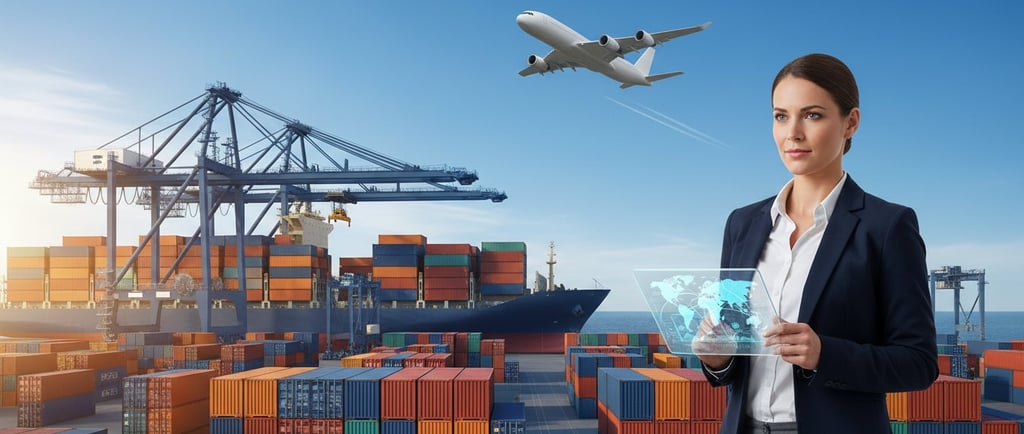
Think of a freight forwarder as a travel agent for your cargo. They are logistics experts who arrange for your bulk products to be moved from one place to another, typically between countries. They don't own the ships, planes, or trucks themselves. Instead, they leverage their extensive network and expertise to manage the entire shipping process on your behalf, ensuring your goods get from your manufacturer to your destination country efficiently.
What a Freight Forwarder Does: Key Responsibilities
A freight forwarder's primary job is to handle the complexities of international, large-scale shipping. Their core tasks include:
Arranging cargo transport via the best route, whether by sea, air, road, or rail.
Preparing and managing all the necessary shipping and customs documents.
Handling customs clearance to ensure your goods enter the country legally.
Negotiating freight charges with shipping lines and carriers to get you the best rates.
What a Freight Forwarder Does NOT Do
This is where the distinction becomes critical for online store owners. A freight forwarder’s role typically ends once your goods have cleared customs and arrived at a designated point in the country.
They generally do not:
Handle individual customer orders from your online store.
Store your inventory long-term for direct-to-consumer sales.
Pick, pack, and ship orders to your customers' homes.
Freight Forwarding vs. 3PL Fulfillment: A Crucial Difference
While the terms are sometimes used interchangeably, they represent two distinct and vital stages of your supply chain.
A freight forwarder gets your bulk stock into the country, while a third-party logistics (3PL) provider gets your products to your customers. Many growing businesses need both, but for completely different jobs. Understanding this difference will save you significant time, money, and headaches.
The Role of a Freight Forwarder
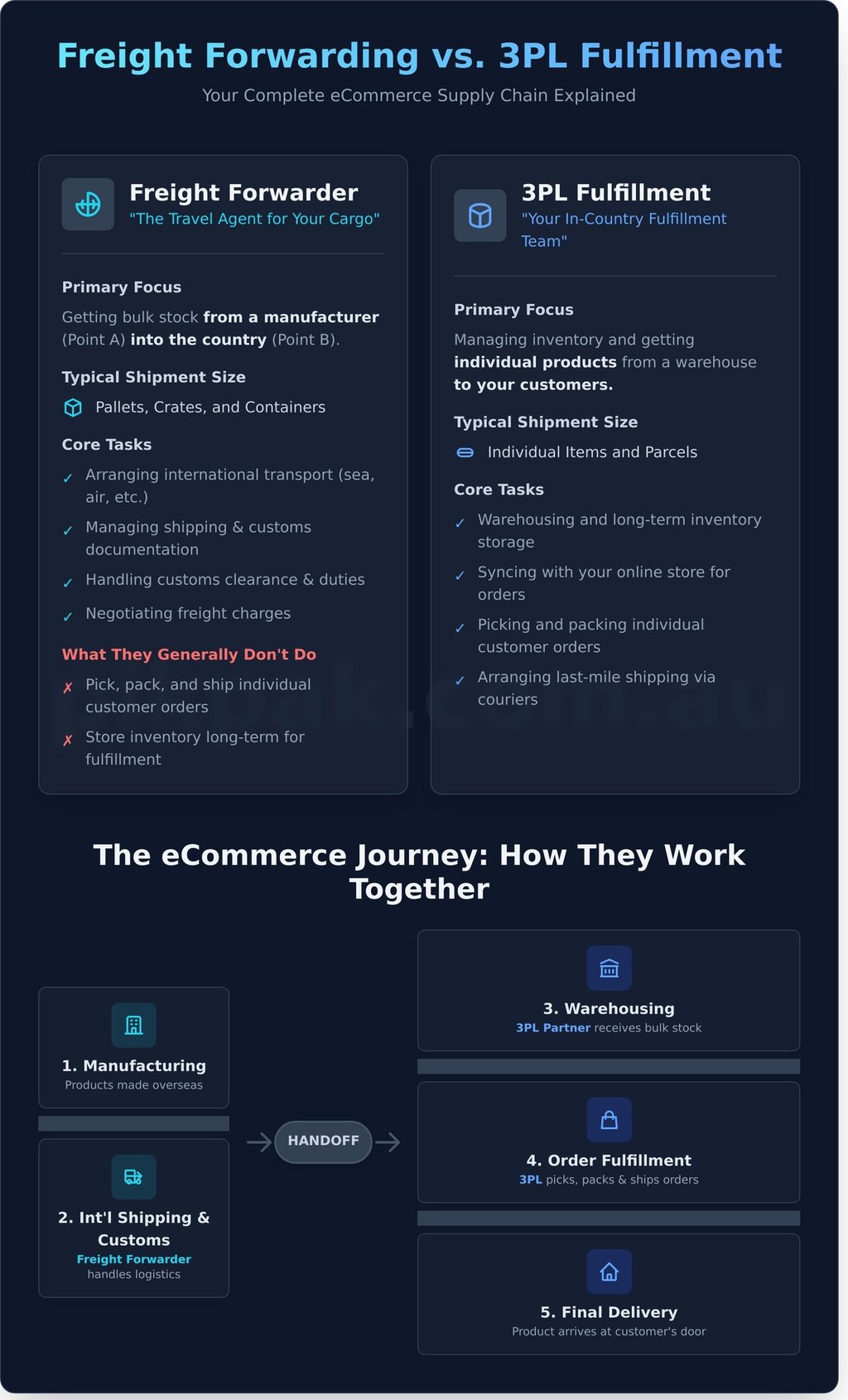
Focus: Getting your bulk stock from Point A (e.g., a factory in China) to Point B (e.g., a port in Australia).
Shipment Size: Pallets, crates, and shipping containers.
Key Task: Managing international logistics, documentation, and customs clearance.
The Role of a 3PL Fulfillment Partner (Like Pik Pak)
Focus: Managing your inventory and fulfilling individual customer orders within a country.
Shipment Size: Individual items and parcels shipped directly to your customers.
Key Tasks: Warehousing, inventory management, picking, packing, and last-mile shipping.
How They Work Together: An eCommerce Example
To make it crystal clear, let's trace a product's journey from an overseas factory to an Australian customer's doorstep, using both a freight forwarder and a 3PL partner like Pik Pak.
Step 1: International Shipping: Your freight forwarder arranges for a container of your products to be shipped from the manufacturer to a port in Sydney or Melbourne.
Step 2: Customs Clearance: The forwarder handles all customs paperwork and duties, ensuring your shipment is cleared for entry into Australia.
Step 3: Delivery to Warehouse: The forwarder then organises for the bulk shipment to be transported from the port to the Pik Pak 3PL warehouse.
Step 4: Inventory Management: The Pik Pak team receives your bulk shipment, unpacks it, and logs the inventory into our Warehouse Management System, which syncs directly with your online store.
Step 5: Order Fulfillment: When a customer in Perth places an order on your website, our system receives it automatically. We then pick the item, pack it securely, and ship it directly to their door.
When Do You Need a Freight Forwarder?
You should partner with a freight forwarder in these specific situations:
When you are importing products from an overseas manufacturer.
When you are dealing with large, bulk shipments (pallets or containers).
When you need a licensed expert to navigate complex customs regulations.
When Do You Need a 3PL Partner?
A 3PL fulfillment partner becomes essential at a different stage:
Once your bulk goods have arrived safely in Australia.
When you need a secure, professional space to store your inventory.
When you want to automate the process of picking, packing, and shipping daily customer orders.
Ready to automate? Let Pik Pak handle the hard work.
Frequently Asked Questions
Is a freight forwarder the same as a customs broker?
Not exactly, but they are closely related. Many freight forwarders have in-house customs brokers or offer brokerage as part of their service. A customs broker is a specialist who deals exclusively with customs documentation and clearance, while a freight forwarder manages the entire transportation process.
What's the difference between a freight forwarder and a courier like Australia Post?
A freight forwarder moves large, bulk quantities of goods, often internationally. A courier handles the final delivery of small, individual parcels directly to customers' addresses (known as the "last mile"). 3PL providers like Pik Pak work with a network of couriers to ensure fast and reliable delivery of your orders.
Can a freight forwarder help with warehousing?
A freight forwarder may offer temporary storage (a few days) at a port or airport facility as part of the transit process. However, they do not provide the long-term warehousing, inventory management, and order fulfillment services that a dedicated 3PL provider offers.
Do I need a freight forwarder for dropshipping?
No. In a dropshipping model, you never handle the goods yourself. Your supplier is responsible for shipping individual products directly to your customers, so you don't need a freight forwarder to move bulk stock.
How do I find a reliable freight forwarder in Australia?
Look for established companies with strong reviews, clear communication, and experience shipping from your specific manufacturing country. Ask for quotes from multiple providers and ensure they have a good understanding of your product type and industry.
By understanding the distinct roles of freight forwarders and 3PL partners, you can build a powerful and efficient supply chain that supports your eCommerce growth. Let the forwarder handle the global journey, and let a specialist partner manage your customer-facing fulfillment. This allows you to stop worrying about logistics and get back to what you do best: growing your brand. Focus on your business, not logistics.
Discover Pik Pak's fulfillment services.
References
FarEye (2024). What is Ecommerce Logistics? Guide to E-commerce Logistics.
https://fareye.com/resources/blogs/ecommerce-logistics-guideShopify Enterprise (2025). Fulfillment Centers and Ecommerce Logistics at Scale.
https://www.shopify.com/enterprise/blog/ecommerce-logistics-at-scaleFulfill.com (2025). 3PL (Third-Party Logistics): 2025 Updated Guide.
https://www.fulfill.com/what-is-3plClickPost (2024). The Ultimate Guide to Third-Party Logistics (3PL) for 2025.
https://www.clickpost.ai/3pl-third-party-logisticsWGU Education (2024). Supply Chain vs. Logistics: Understanding the Key Differences.
https://www.wgu.edu/blog/supply-chain-logistics-understanding-key-differences2307.htmlCin7 (2025). Reverse Logistics: The Ultimate Guide for E-Commerce Operations.
https://www.cin7.com/blog/reverse-logistics/NetSuite (2025). A Guide to Reverse Logistics: How It Works, Types and Strategies.
https://www.netsuite.com/portal/resource/articles/inventory-management/reverse-logistics.shtmlFreightAmigo (2025). 2025 eCommerce Shipping Expectations: Fast, Free, and Flexible.
https://www.freightamigo.com/en/blog/ecommerce-logistics/the-evolution-of-consumer-expectations-in-ecommerce-navigating-the-new-
Contact us
Useful Links
Established in 2007, Pik Pak specialises in warehousing and order fulfilment services designed specifically for online stores and eCommerce brands.
(c) 2025 All rights reserved.
Pik Pak Logistics Pty Ltd, ABN: 81 130 329 912
Our Partners