What is an e-Storefront? The Backend Engine for Your Online Sales
This guide will show you how both halves work together and why the backend is the key to scaling your business without the headaches.
3PL GUIDEECOMMERCE FULFILLMENT
Pik Pak Digital
12/19/20255 min read
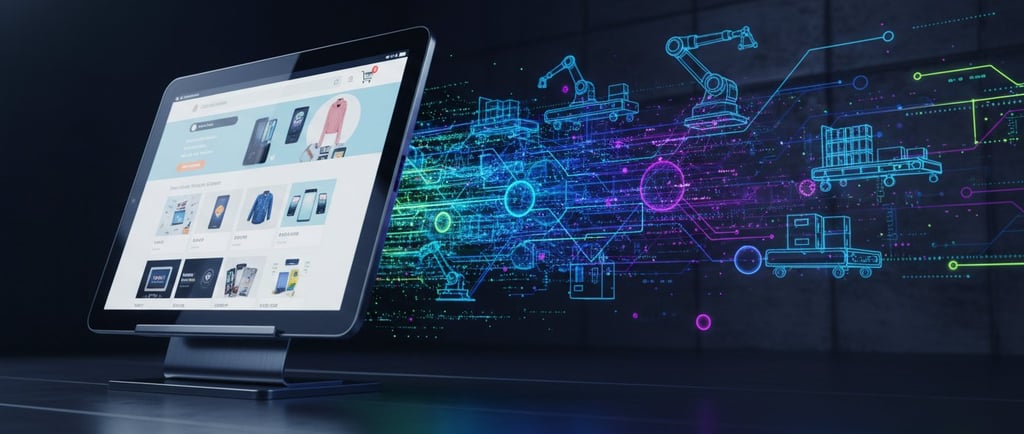
When you hear the term "e-storefront", you probably picture your website, the digital shop window where customers browse products, add items to their cart, and make a purchase.
You are right, but that's only half the story. A truly effective e-storefront has two critical parts: the beautiful, customer facing shop and the powerful, unseen backend engine that handles everything after the "buy" button is clicked.
This guide will show you how both halves work together and why the backend is the key to scaling your business without the headaches.
Understanding the Two Halves of Your e-storefront
Think of your eCommerce business as a theatre production. The audience only sees the stage, the actors, the set and the lighting. But behind the curtain, a massive crew is working to make the show run smoothly.
Your e-storefront is the same. It has a customer facing side that makes the sale and an operational hub that makes the delivery happen.
The Customer-Facing Storefront: Your Digital Shop Window
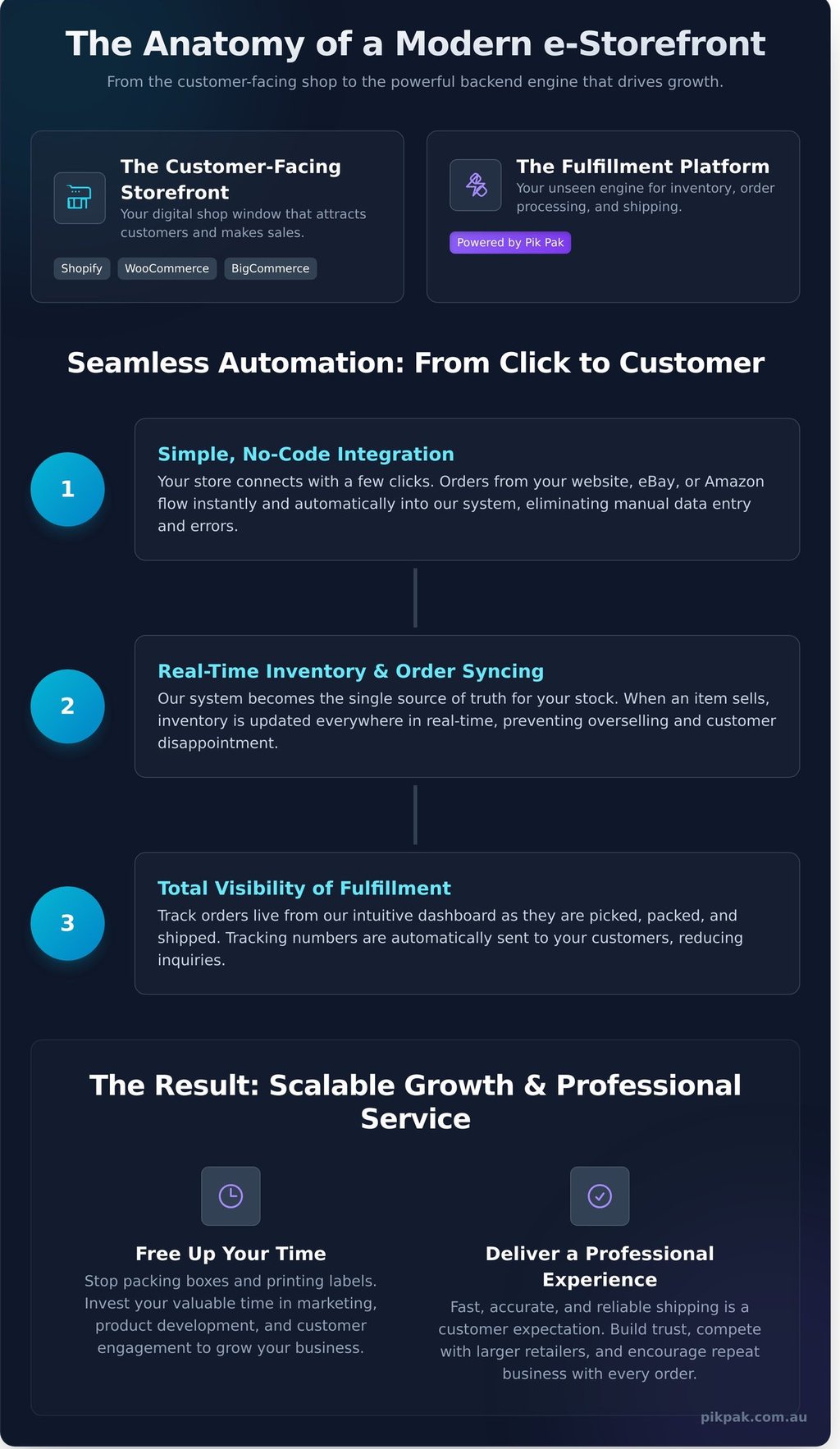
This is the part of your e-storefront everyone knows. It's your website, likely built on a popular platform like Shopify, WooCommerce, or BigCommerce.
This is where you invest in branding, photography, and compelling product descriptions. The primary goal of your customer-facing shopfront is to attract visitors, provide a great shopping experience, and convert them into paying customers.
The Fulfillment Platform: Your Business's Mission Control
This is the backend engine that customers never see, but you can't run your business without it. Once an order is placed, this fulfillment platform is where you manage your inventory, process the order, and coordinate shipping.
For many growing businesses, this is a manual, time-consuming process. However, with a third-party logistics (3PL) partner like Pik Pak, this operational hub becomes a powerful, automated system that handles the hard work for you.
How Pik Pak's Platform Connects to Your Online Store
Seamless integration between your sales channel and your fulfillment platform is what makes your logistics run like clockwork.
Instead of you manually transferring order details, our system connects directly to your store via an API. This simple connection automates the entire process, from the moment a customer clicks "buy" to the moment the package arrives at their door.
Step 1: Simple, No-Code Integration
You don't need to be a tech geek to get started. Our platform is designed for easy, no-code integration, allowing you to connect your store with just a few clicks.
As soon as you're connected, orders from your website flow directly and instantly into our warehouse management system. This completely eliminates the need for manual data entry, saving you time and preventing costly human errors.
Step 2: Real-Time Inventory & Order Syncing
Once connected, our system becomes the single source of truth for your inventory. When an item is sold on your website, your stock levels are updated in our warehouse and on your shopfront automatically.
This real-time syncing is crucial for preventing overselling, which can lead to cancelled orders, disappointed customers, and damage to your brand's reputation.
Step 3: Total Visibility of the Fulfillment Process
Automation doesn't mean you lose control. Our intuitive dashboard gives you complete visibility over your entire logistics operation.
You can track orders in real-time as our team picks, packs, and ships them. You'll have access to all shipping information and tracking numbers, which are automatically sent to your customers, keeping them informed and reducing "where is my order?" inquiries.
See how our technology works and discover how simple managing your operations can be.
Why a Connected e-Storefront is Key to Scaling Your Business
An integrated system that connects your sales and fulfillment removes the operational headaches that hold businesses back.
It allows you to handle a growing volume of orders efficiently, so you can sell more without having to work harder on the day-to-day logistics.
Free Up Your Time to Focus on Your Business
Imagine your business without the daily grind of printing labels, packing boxes, and making trips to the post office.
By outsourcing your fulfillment to Pik Pak, you can stop spending hours on manual logistics and start investing that valuable time where it matters most: marketing, product development, and customer engagement.
We do the hard work for you so you can focus on growing your business.
Deliver a Professional Experience Every Time
In today's competitive eCommerce landscape, customer experience is everything. Fast, accurate, and reliable shipping is no longer a luxury, it's an expectation.
An integrated fulfillment system ensures every order is processed professionally, helping you build customer trust and compete with larger retailers.
We also effortlessly manage returns, providing a seamless end-to-end experience that encourages repeat business. Let Pik Pak handle your logistics. Get a free quote today.
Frequently Asked Questions
What is the difference between an e-storefront and an eCommerce platform?
An eCommerce platform (like Shopify) is the software you use to build your customer-facing website. The e-storefront is the combination of that website and the backend fulfillment system that processes the orders it generates. Pik Pak provides the essential backend fulfillment part of the equation.
Do I need to be a developer to integrate my store with Pik Pak?
Absolutely not. Our system is designed for business owners, not developers. We provide simple, point-and-click integrations for all major eCommerce platforms, so you can connect your store in minutes without writing a single line of code.
Which eCommerce platforms can connect to Pik Pak's system?
Our platform integrates with all major eCommerce solutions, including Shopify, WooCommerce, BigCommerce, Magento, and more. We also support marketplace connections like eBay and Amazon, allowing you to centralise your fulfillment from multiple sales channels.
How does your platform help manage inventory across multiple sales channels?
Our Warehouse Management System (WMS) acts as a central hub for your inventory. If you sell on your own website and on a marketplace like eBay, our system syncs your stock levels across both. When an item sells on one channel, the inventory is updated everywhere, preventing you from selling the same item twice.
Can I still see all my order details in one place?
Yes. Our client dashboard gives you a complete, real-time overview of all your orders, regardless of which sales channel they came from. You can track the status of every order, view shipping details, check inventory levels, and manage your entire logistics operation from one easy-to-use portal.
Ready to connect your e-storefront to a powerful backend engine? Stop letting logistics slow you down. Let Pik Pak provide the seamless fulfillment that frees you up to focus on growth. Contact us today to get a personalised quote and discover how easy it is to put your order fulfillment on autopilot.
References
E-commerce Storefront vs. Backend Operations
1, BigCommerce: Key Components of E-commerce Backend - bigcommerce.com
2, Svitla: The Role of Backend in Customer Experience - svitla.com
3, Fabric: E-Commerce Frontend Vs Backend Differences - fabric.inc
Third-Party Logistics (3PL) & Warehouse Management
4, SB: 3PL Services & Guide - shipbob.com
5, Manhattan Associates: What is a Warehouse Management System (WMS)? - manh.com
6, Nogin: 3PL E-commerce Fulfillment Processes - nogin.com
7, VGS Software: How WMS Enhances Order Fulfillment - vgssoftware.co
Omnichannel Integration
8, Fulfilio: Omnichannel Integration of Sales Channels - fulfilio.com
9, Orisha: Unified Inventory Management - commerce.orisha.com
10, Webgility: Guide to Multi-channel Inventory Management - webgility.com
11, Exorigo: Sales Channel Integration & Unified Commerce - exorigo-upos.com
Customer Experience & Personalization Stats
12, CSG/McKinsey: 71% of consumers expect personalized interactions - csgi.com
13, Adam Connell: E-commerce Personalization Statistics - adamconnell.me
14, Shopify: 10 Ways to Create Personalized Experiences - shopify.com
15, Centric Software: AI-Driven Hyper-Personalized Shopping - centricsoftware.com
Real-Time Inventory & Automation
16, EcomBiz: Preventing Overselling with Real-Time Sync - ecombiz.ai
17, Loop: How Inventory Syncing Apps Prevent Overselling - loopwork.co
18, Shopify: Benefits of Automated Order Fulfillment - shopify.com
19, Red Stag: Strategic Benefits of Using a 3PL - redstagfulfillment.com
Defining Seamless Experience
20, GoCardless: What Is a Seamless Shopping Experience? - gocardless.com
21, Sprinklr: How to Craft a Seamless Customer Journey - sprinklr.com
Contact us
Useful Links
Established in 2007, Pik Pak specialises in warehousing and order fulfilment services designed specifically for online stores and eCommerce brands.
(c) 2025 All rights reserved.
Pik Pak Logistics Pty Ltd, ABN: 81 130 329 912
Our Partners