What is a Warehouse? A Complete Guide for eCommerce Businesses
This guide will help you understand exactly how a modern warehouse functions and discover the smart way to manage your inventory and shipping without the headache.
3PL GUIDEECOMMERCE FULFILLMENT
Pik Pak Digital
12/26/20256 min read
As an online business owner, you're an expert in your products, marketing, and customers. But as your store grows, you'll inevitably face the challenge of logistics.
The term "warehouse" might bring to mind a dusty, giant shed, but in today's eCommerce world, it's so much more.
This guide will help you understand exactly how a modern warehouse functions and discover the smart way to manage your inventory and shipping without the headache.
What is a Warehouse? More Than Just a Big Shed
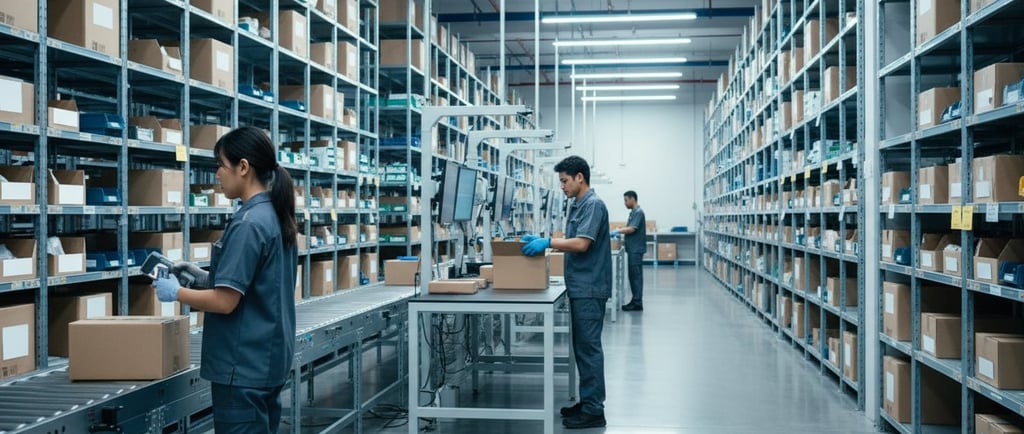
Forget the old image of a simple storage building. For a modern eCommerce business, a warehouse is the dynamic, high-tech engine room that powers your entire operation.
It’s not just a place to store products; it's a central hub where your inventory is received, sorted, organised, picked for orders, packed securely, and dispatched to your customers.
A well-run warehouse is the key to happy customers and a scalable business.
The Core Functions of an eCommerce Warehouse
A successful warehouse operation is a symphony of coordinated tasks.
Each step is crucial for ensuring orders are fulfilled accurately and efficiently. The main functions include:
Receiving: This is the first step where new inventory arrives from your suppliers. Warehouse staff check the delivery for accuracy and damage, then officially book the items into the management system.
Storage: Once received, products are put away in designated, organised locations. Efficient storage ensures items are safe, easy to find, and space is maximised.
Picking: When a customer places an order, a staff member (or "picker") uses an order sheet to locate the correct items on the shelves. Accuracy here is vital.
Packing: The picked items are taken to a packing station. Here, they are checked one last time, securely packaged with appropriate materials, and the shipping label is applied.
Shipping: The final step is dispatch. Packed orders are sorted by courier and collected for delivery to your customers.
Types of Warehouses: Which One Do You Need?
Not all warehouses are created equal. Depending on your business size and needs, you might encounter a few different types:
Private Warehouse: This is a facility owned and operated by a single, large company for its own use, like Amazon's massive distribution centres. This is out of reach for most small and medium-sized businesses.
Public/Shared Warehouse (3PL): In this model, a Third-Party Logistics (3PL) company owns or leases the warehouse and rents out space and services to multiple businesses. It’s a flexible and cost-effective solution.
Fulfillment Center: This is a type of 3PL warehouse that is specifically designed and optimised for processing online orders directly to customers. They are experts in the pick, pack, and ship process for eCommerce.
The Big Decision: Run Your Own Warehouse vs. Outsourcing to a 3PL
As your business grows beyond what you can manage from your garage or spare room, you face a critical choice: build your own logistics operation or partner with an expert.
Let's break down the two main paths for managing your inventory and fulfillment.
The DIY Approach: What's Really Involved?
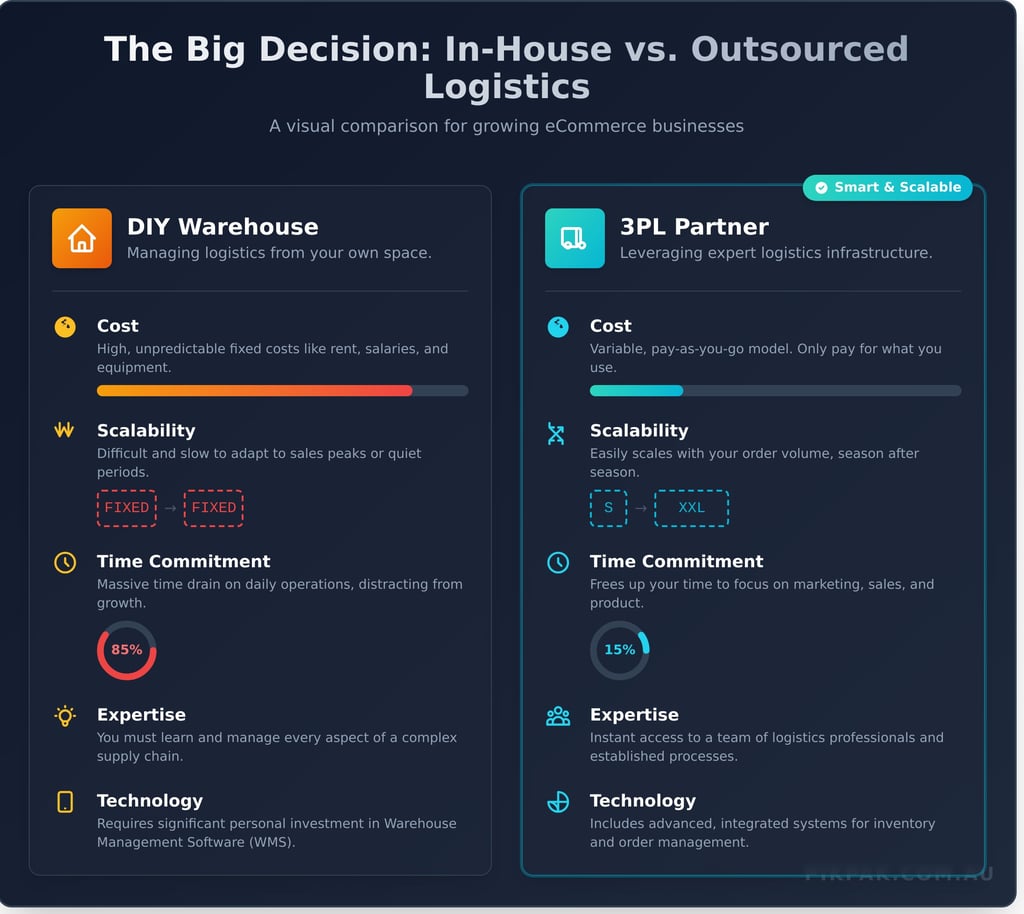
Running your own warehouse gives you complete control, but it comes with significant responsibilities and costs. You would need to handle finding and signing a long-term lease on a commercial space, hiring, training, and managing warehouse staff, and purchasing all the necessary equipment like shelving, packing stations, and potentially even forklifts.
On top of that, you're responsible for managing software, insurance, security, and all the daily operational challenges. This path offers total control but requires a massive investment of time and capital.
The 3PL Approach: The Smart, Scalable Alternative
The alternative is to partner with a Third-Party Logistics (3PL) provider like Pik Pak.
When you work with a 3PL, you leverage their existing infrastructure, their warehouse, their trained staff, and their advanced technology.
Instead of facing huge fixed costs, you pay only for the storage space you use and the orders they ship on your behalf.
This model allows you to focus your energy and resources on growing your business, leaving the complex work to logistics experts.
See how Pik Pak makes warehousing easy.
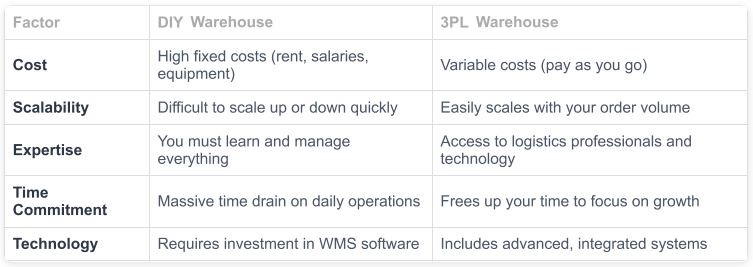
DIY vs. 3PL Warehouse: A Quick Comparison
5 Signs Your eCommerce Business Has Outgrown the Garage
Not sure if you're ready to outsource your warehousing and fulfillment?
The transition point is different for every business, but there are some clear signs that it's time to make a change and partner with a professional.
1. You Spend More Time Packing Than Selling
Is your daily to-do list dominated by printing labels, finding the right size box, and taping up parcels?
Every hour you spend on manual fulfillment is an hour you aren't spending on marketing, customer service, or developing new products.
If logistics is consuming your day, it's time to outsource.
2. Your Home is Overflowing with Inventory
When every spare room, closet, and corner of the garage is filled with stock, you have a problem.
Not only is it stressful, but it also makes it nearly impossible to manage your inventory effectively.
A disorganized system leads to lost stock, damage, and difficulty in knowing what you need to reorder.
3. Order Mistakes Are Starting to Happen
As your order volume increases, so does the chance of human error.
Sending the wrong item, size, or colour can damage your brand's reputation and lead to unhappy customers and costly returns.
A professional fulfillment center uses systems and processes to ensure near-perfect accuracy.
4. You Can't Keep Up with Shipping Demands
Modern customers expect fast and affordable shipping.
As a small business, it's difficult to negotiate competitive rates with couriers.
A 3PL ships thousands of parcels a day, giving them access to bulk shipping discounts and faster dispatch options that you can pass on to your customers.
5. Your Growth Has Stalled
Are you hesitant to run a big sale or a major marketing campaign because you're afraid you won't be able to handle the surge in orders?
If your own fulfillment capacity has become a bottleneck that prevents you from scaling, you are actively limiting your own success.
If this sounds familiar, it's time to talk to a logistics expert.
Frequently Asked Questions
What's the difference between a warehouse and a fulfillment center?
While all fulfillment centers are warehouses, not all warehouses are fulfillment centers.
A general warehouse is often focused on long-term storage of bulk goods (B2B).
A fulfillment center is a specific type of warehouse optimized for picking, packing, and shipping small orders directly to consumers (D2C).
How much does it cost to use a 3PL warehouse?
Costs are variable and based on your usage.
You'll typically be charged for three main things: receiving and storing your inventory (often per pallet or bin), picking and packing each order (a per-item or per-order fee), and the actual cost of shipping.
Is my business too small for a 3PL provider?
Not at all! Many 3PLs, including Pik Pak, are designed to work with small and growing businesses.
The pay-as-you-go model makes it an accessible and scalable solution, whether you ship 30 orders a month or 3,000.
Will I lose control of my brand if I outsource fulfillment?
No. A good 3PL partner acts as an extension of your brand.
You can use custom branded packaging, and their professional service ensures your customers have a positive delivery experience.
You maintain control through their software, which gives you real-time visibility into your inventory and orders.
How do I get my products to the 3PL warehouse?
The process is straightforward.
You simply arrange for your supplier to ship your inventory directly to the 3PL's warehouse address. Their team will handle the receiving process and notify you once the stock is checked in and ready for sale.
Making the leap from at-home fulfillment to a professional warehouse solution is a major step in the growth of your eCommerce business.
It’s about more than just finding storage space; it’s about buying back your time, improving your customer experience, and building a scalable foundation for future success.
With a pay-as-you-go model and no lock-in contracts, partnering with a 3PL removes the risk and headache, so you can focus on what you do best. Ready to free up your time? Get a custom quote from Pik Pak.
References
A Comprehensive Guide to Warehouse Operations in 2025 - https://www.goramp.com/blog/warehouse-operations
Warehouse Management: A Complete Guide (2025) - https://www.hopstack.io/guides/warehouse-management-guide
10 Key Features of a Warehouse Management System - https://www.mintsoft.com/warehouse-management/10-key-features-of-a-warehouse-management-system/
The Complete Guide to Warehouse Management Systems - https://www.logiwa.com/complete-guide-to-warehouse-management-systems
3PL Warehousing & Management Guide - https://www.extensiv.com/what-is-a-3pl
Self-managed vs. outsourced warehousing: Which is better? - https://www.odysseylogistics.com/blog/self-managed-vs-outsourcing-warehousing-which-is-right-for-your-business/
The definitive guide to fulfillment centers - https://www.logiwa.com/fulfillment-center
Best Practices for Warehouse Inventory Management in 2024 - https://www.srs-i.com/blog/best-practices-for-warehouse-inventory-management-in-2024/
Warehouse Types: Complete Guide to Different Storage Solutions - https://www.finaleinventory.com/warehouse-management-system-software/warehouse-types
What Is Automated Inventory Management? - https://www.netsuite.com/portal/resource/articles/inventory-management/automated-inventory-management.shtml
RFID Warehouse Tracking System Solutions - https://datascan.com/rfid-warehouse-tracking-system/
The Benefits of Scalable Warehousing Solutions - https://www.ameraware.net/the-benefits-of-scalable-warehousing-solutions/
Contact us
Useful Links
Established in 2007, Pik Pak specialises in warehousing and order fulfilment services designed specifically for online stores and eCommerce brands.
(c) 2025 All rights reserved.
Pik Pak Logistics Pty Ltd, ABN: 81 130 329 912
Our Partners