How to Start an eCommerce Business in Australia: A Complete Guide
This guide breaks down the essential steps to launch and scale a successful eCommerce business in Australia.
3PL GUIDEECOMMERCE FULFILLMENT
Pik Pak Digital
12/20/20258 min read


Starting an online store is an exciting venture, but it can feel overwhelming. You have a great product idea, but what comes next?
This guide breaks down the essential steps to launch and scale a successful eCommerce business in Australia. We'll walk you through everything from finding your perfect product to mastering the logistics that can make or break your brand, giving you a clear path to follow.
What is an eCommerce Business? (And Why Start One in Australia?)
In simple terms, an eCommerce business is any business that sells products or services over the internet. Instead of a physical shopfront, your store is a website, and you can reach customers anywhere, anytime.
The benefits are significant: you can enjoy lower startup costs compared to traditional retail, reach a national or even global audience from day one, and make sales 24/7.
The Australian eCommerce market continues to grow, presenting a massive opportunity for new entrepreneurs in 2026 and beyond.
Shoppers are more comfortable than ever buying online, and there are countless niches waiting for the right brand to serve them. The main business models include dropshipping (where a third party ships for you), private label (creating your own brand), and holding your own stock.
Choosing Your Business Model
The model you choose will define your startup costs and daily operations. The three most common paths are:
Dropshipping: With this model, you never handle the product yourself. When a customer places an order, you forward it to a supplier who ships it directly to them. It's low-risk and requires minimal investment, but you have less control over quality and shipping times, and profit margins are typically lower.
Manufacturing: This involves creating your own unique product. It gives you complete control over the brand and quality, leading to higher potential profit margins. However, it also requires the largest upfront investment in design, prototyping, and production.
Wholesale: This is a middle ground where you buy existing products from established brands in bulk and resell them. It's simpler than manufacturing and offers more control than dropshipping, but you need capital to purchase inventory upfront.
Phase 1: Finding Your Niche and Planning for Success
Before you even think about a website, you need to lay a solid foundation. This planning phase is the most critical part of building a long-lasting business.
Getting these first steps right will save you time, money, and headaches down the road.
How to Find a Profitable Product or Niche
The best product ideas often come from solving a problem, either your own or one you observe in others.
Start by brainstorming ideas based on your passions, hobbies, and professional experience. Once you have a list, validate the demand.
Use free tools like Google Trends to see if people are actively searching for your product ideas. Finally, analyse potential competitors. Look for gaps in the market or ways you can offer a better product, a unique brand story, or a superior customer experience.
Creating a Simple Business Plan
A business plan doesn't need to be a hundred-page document.
A simple, one-page plan is enough to give you clarity and direction.
Start by defining your ideal target audience: who are they, and what do they care about? Then, outline your product lineup, decide on a pricing strategy, and create an initial budget for inventory, marketing, and website costs.
Most importantly, set realistic and measurable goals for your first 6 to 12 months.
Business Registration and Legal Basics in Australia
Getting your business set up correctly from the start is crucial.
First, choose a business name and check that it's available as both a registered business name and a website domain.
Next, you'll need to register for an Australian Business Number (ABN), which is a unique identifier for your business.
It's also important to understand your obligations regarding the Goods and Services Tax (GST). In Australia, you must register for GST if your business has a turnover of $75,000 or more per year.
Phase 2: Building Your Online Store
With your plan in place, it's time to build your digital shopfront. The goal is to create a professional, trustworthy, and easy-to-use website that encourages visitors to become customers. Focus on a clean design and a simple checkout process.
Choosing the Right eCommerce Platform
You don't need to be a web developer to build a beautiful online store. eCommerce platforms provide all the tools you need. The main options are:
Hosted platforms like Shopify: These are perfect for beginners. They handle all the technical aspects for a monthly fee, so you can focus on selling. They are easy to set up and come with great support.
Self-hosted platforms like WooCommerce: This is a plugin for WordPress that gives you more flexibility and control. It has a steeper learning curve and requires you to manage your own hosting, but it can be more cost-effective in the long run.
When choosing, look for key features like professional themes, secure payment options (like Stripe and PayPal), and a robust app store to add extra functionality.
Designing Your Website and Writing Product Descriptions
First impressions matter. Invest in high-quality product photos that show your items from multiple angles. For your product descriptions, go beyond listing features and focus on the benefits.
Explain how your product solves your customer's problem or improves their life. Finally, ensure your website is fully responsive and looks great on mobile phones, as a large portion of online shoppers will be browsing on their devices.
Phase 3: Managing Inventory and Orders
This is where the real work of eCommerce begins, and it's the area where most new business owners face their biggest challenges.
An efficient system for managing inventory and fulfilling orders is essential for keeping customers happy and encouraging repeat business.
Storing Your Products: The Garage vs. a Warehouse
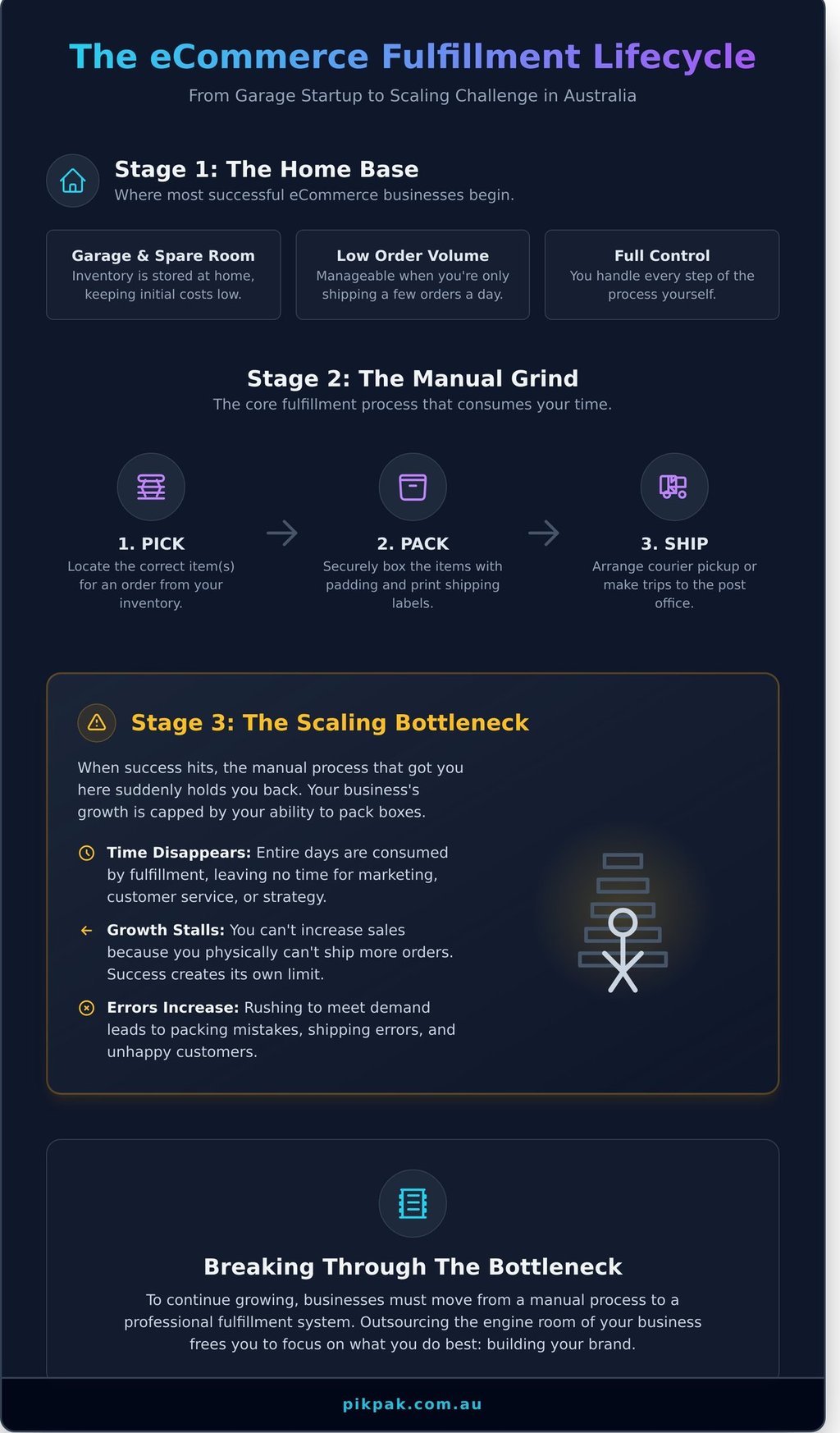
Most eCommerce businesses start with inventory stored in a spare room, garage, or home office. This works well initially, as it keeps costs down.
However, as you grow, your home can quickly become overrun with boxes. The hidden costs of self-storage, like time spent organising stock, travel to a separate storage unit, and the need for insurance, can add up quickly. You need to ask yourself when it makes sense to look for a more professional space.
The Pick, Pack, and Ship Process Explained
From the moment a customer clicks "buy," a multi-step process begins. First, you have to "pick" the correct item from your inventory.
Then, you "pack" it securely in the right-sized box with appropriate padding to prevent damage. Finally, you have to "ship" it by printing a label, choosing the right courier, and arranging for pickup or dropping it off.
This manual process is time-consuming and prone to errors, especially as order volumes increase.
The Scaling Problem: When Success Creates a Bottleneck
What happens when your marketing efforts pay off and you get 50 orders in a single day? While exciting, this is often the point where success creates a major bottleneck.
Suddenly, your entire day is consumed by printing labels, packing boxes, and running to the post office. You have no time left for marketing, customer service, or strategic planning. This is the moment your business's growth is held back by your inability to keep up with the manual labour of fulfillment.
Feeling the pressure? See how fulfillment services can help.
Phase 4: Launching and Scaling Your Business
Once you have a plan to manage your operations, you can confidently launch and focus on what truly matters: getting your first customers and planning for sustainable growth.
A smart logistics strategy allows you to concentrate on marketing while a trusted partner handles the rest.
Simple Marketing Strategies to Get Your First Sales
You don't need a huge marketing budget to make an impact. Start by leveraging social media platforms where your target audience spends their time.
Share high-quality content, engage with followers, and build a community around your brand. Email marketing is also incredibly powerful for retaining customers; encourage sign-ups and send out valuable content and exclusive offers.
As you grow, you can consider exploring paid advertising on platforms like Google or Facebook to reach a wider audience.
Outsourcing Fulfillment: How a 3PL Partner Works
The smartest way to scale your eCommerce business is to focus on your strengths, like marketing and product development, and outsource your weaknesses.
A third-party logistics (3PL) provider is a company that stores your inventory and handles the entire pick, pack, and ship process for you.
Their system integrates directly with your online store, so when an order comes in, it's automatically sent to their warehouse for fulfillment.
This pay-as-you-go model is surprisingly affordable for small businesses and eliminates the biggest operational headache, allowing you to grow without limits.
FAQs
How much does it cost to start an eCommerce business in Australia?
Costs can vary widely. You can start a dropshipping business for a few hundred dollars to cover your website platform subscription and marketing. If you're buying inventory, costs can range from $2,000 to $10,000+ depending on your product.
Do I need to register for GST straight away?
No. In Australia, you are only required to register for GST once your business turnover reaches $75,000 in a 12-month period. Many small businesses start without being registered for GST.
Can I run an eCommerce business from home?
Absolutely. Most eCommerce businesses start from home. It's a great way to keep overheads low. You only need to consider external storage or fulfillment services when you start running out of space or time.
What is the most profitable type of eCommerce business?
Profitability depends more on the niche and execution than the business type. Businesses selling unique, high-margin products in a niche with loyal customers tend to be the most profitable.
How do I handle customer returns?
Have a clear and fair returns policy listed on your website. The process typically involves the customer contacting you, shipping the item back, and you issuing a refund or exchange once it's received. A 3PL partner can also manage this entire reverse logistics process for you.
When should I consider using a 3PL service like Pik Pak?
You should start considering a 3PL when you find that packing orders is taking up more than a few hours of your day, you're running out of storage space at home, or you want to offer faster, more competitive shipping options to your customers.
Starting an eCommerce business is a journey of learning and adaptation. By building a solid plan and thinking about your operational strategy from the beginning, you set yourself up for long-term success.
Don't let the daily grind of packing boxes hold you back from building the brand of your dreams. Focus on growth and let an expert partner handle the logistics. Ready to grow? Let Pik Pak handle the hard work for you.
References
Business Address: https://www.anytimeoffices.com.au/do-you-need-a-business-address-for-your-e-commerce-business/
Registering for GST: https://www.gstregister.com.au/crossing-over-the-75000-gst-threshold/
Registering for GST: https://www.ato.gov.au/businesses-and-organisations/gst-excise-and-indirect-taxes/gst/registering-for-gst
Registering Australian Business Number : https://www.service.nsw.gov.au/referral/register-an-australian-business-number-abn
Ecommerce: https://appkodes.com/blog/ecommerce-business-models/
Ecommerce Models: https://www.linkedin.com/pulse/what-best-ecommerce-business-models-2024-muhammad-bilal-newgf
Ecommerce Models: https://virtocommerce.com/blog/types-of-ecommerce-business-models
Ecommerce Marketing: https://blog.commissionfactory.com/ecommerce-marketing/australia-ecommerce-statistics
Australian Ecommerce Market: https://www.mordorintelligence.com/industry-reports/australia-ecommerce-market
Ecommerce Fulfilment Strategies: https://warespace.com/articles/ecommerce-and-warehousing/top-3-ecommerce-fulfillment-strategies-to-fulfill-online-orders
Ecommerce Fulfillment Guide: https://flow.space/blog/ecommerce-fulfillment-guide/
Ecommerce Fulfillment Guide: https://ecommercegermany.com/blog/5-e-commerce-fulfillment-strategies-for-2025/
Ecommerce Fulfillment Guide: https://www.shopify.com/blog/dropshipping-vs-wholesale
Ecommerce Returns: https://www.choice.com.au/shopping/consumer-rights-and-advice/your-rights/articles/refunds-and-returns-your-rights
Ecommerce Returns: https://www.sa.gov.au/topics/rights-and-law/consumer-rights/refunds-and-returns
Ecommerce Shopify vs Big Commerce: https://www.chargeflow.io/blog/shopify-vs-bigcommerce
Ecommerce Shopify vs Big Commerce: https://www.shopify.com/compare/shopify-vs-bigcommerce
Ecommerce Website Builders: https://www.websitebuilderexpert.com/ecommerce-website-builders/comparisons/shopify-vs-woocommerce-vs-bigcommerce/
Ecommerce Fulfillment Guide: https://ninjalogistics.com.au/services/3pl-australia/
Ecommerce Australia Market: https://www.expertmarketresearch.com.au/reports/australia-e-commerce-market
Contact us
Useful Links
Established in 2007, Pik Pak specialises in warehousing and order fulfilment services designed specifically for online stores and eCommerce brands.
(c) 2025 All rights reserved.
Pik Pak Logistics Pty Ltd, ABN: 81 130 329 912
Our Partners