
The Australian eCommerce market is a landscape of immense opportunity, but navigating its unique challenges requires a smart strategy. For entrepreneurs and established businesses alike, understanding the key market trends, choosing the right platforms, and mastering the logistics of a vast continent are crucial for success. This guide provides a complete overview of the Australian eCommerce market, giving you a clear roadmap from launching your online store to scaling it effectively.
The State of eCommerce in Australia: A 2025 Snapshot
Australia’s digital economy is thriving, with online shopping becoming a fundamental part of daily life for millions. This growth presents a significant opportunity for businesses that can meet and exceed customer expectations. To succeed, it’s vital to understand the current state of play, from key growth statistics and popular product categories to the specific desires of the modern Australian shopper. Insights from resources like the Australia Post eCommerce Report highlight a consumer base that values speed, choice, and a seamless service experience above all else.
Key Statistics Every Entrepreneur Should Know
The Australian eCommerce market continues its impressive upward trajectory, with its total value projected to reach new heights over the next three years. This growth is fueled by high consumer confidence and an increasing preference for the convenience of online shopping. The average online spend per capita in Australia remains one of the highest in the region, indicating a customer base with strong purchasing power. Furthermore, mobile commerce (m-commerce) is a dominant force, with a significant majority of online purchases now being made on smartphones, making a mobile-first website strategy non-negotiable.
Popular eCommerce Platforms & Marketplaces in Australia
Choosing where to sell your products is one of the most critical decisions you’ll make. In Australia, the dominant eCommerce platforms for building your own brand store are Shopify, WooCommerce, and BigCommerce, each offering a robust set of tools for businesses of all sizes. Alongside these, established online marketplaces provide access to huge, built-in audiences. Major players include Amazon Australia, eBay, and local giants like Catch and The Iconic. The right strategy often involves a mix of channels, using marketplaces for customer acquisition while driving loyal customers to your own D2C website.
How to Launch Your eCommerce Business in Australia: A 5-Step Guide
Starting an online store can seem daunting, but breaking it down into manageable steps makes the process straightforward. This simplified checklist focuses on the absolute essentials, helping you get your business registered, your store built, and your first sale made without getting lost in the details. By focusing on a solid foundation, you can launch with confidence and set yourself up for long-term growth.
Step 1: Choose Your Business Model & Niche
Your business model defines how you source and sell products. The Direct-to-Consumer (D2C) model involves creating your own brand and selling directly to customers, offering high margins and brand control. Dropshipping, where you sell products that are shipped directly from a third-party supplier, offers low startup costs but can present challenges with shipping times and quality control in the Australian market. Alternatively, selling on established marketplaces allows you to leverage existing traffic, which is a great way to test products and build initial sales momentum.
Step 2: Handle the Business Basics
Before you can sell anything, you need to get your legal and financial structure in place. The first step for any Australian business is registering for an Australian Business Number (ABN). As you grow, it’s crucial to understand your obligations regarding the Goods and Services Tax (GST), which generally applies once your business reaches a certain revenue threshold. Finally, setting up a dedicated business bank account and integrating reliable payment gateways like Stripe or PayPal into your store are essential for professional financial management and a smooth customer checkout experience.
Step 3: Build Your Online Store
With the administrative tasks handled, it’s time to create your digital storefront. Select an eCommerce platform that aligns with your technical skills and business goals. Your store’s design must be mobile-friendly and provide a secure, trustworthy checkout process to maximize conversions. Invest time in crafting compelling product descriptions that highlight benefits, not just features, and use high-quality photos and videos to showcase your products in the best possible light. These elements build trust and directly influence a customer’s decision to buy.
The Hidden Hurdle: Mastering eCommerce Fulfilment & Shipping
Launching your store is just the beginning. The real challenge, especially in Australia, is getting your products to customers quickly, reliably, and cost-effectively. Logistics can make or break an eCommerce business. The country’s vast geography presents unique shipping challenges, and customer expectations for fast, free delivery are higher than ever. As your business grows, the “pack and ship from the garage” model quickly becomes unsustainable. Professionalising your operations is not a luxury; it’s a necessity for scaling.
What is Order Fulfilment? The Pick, Pack, Ship Process
Order fulfilment is the entire process that happens behind the scenes from the moment a customer clicks “buy” to when the package arrives at their door. It starts with receiving and securely storing your inventory in a warehouse. When an order comes in, the correct products must be accurately picked from the shelves. Finally, the order is packed safely to prevent damage in transit, the correct shipping label is applied, and it’s dispatched with a carrier for delivery.
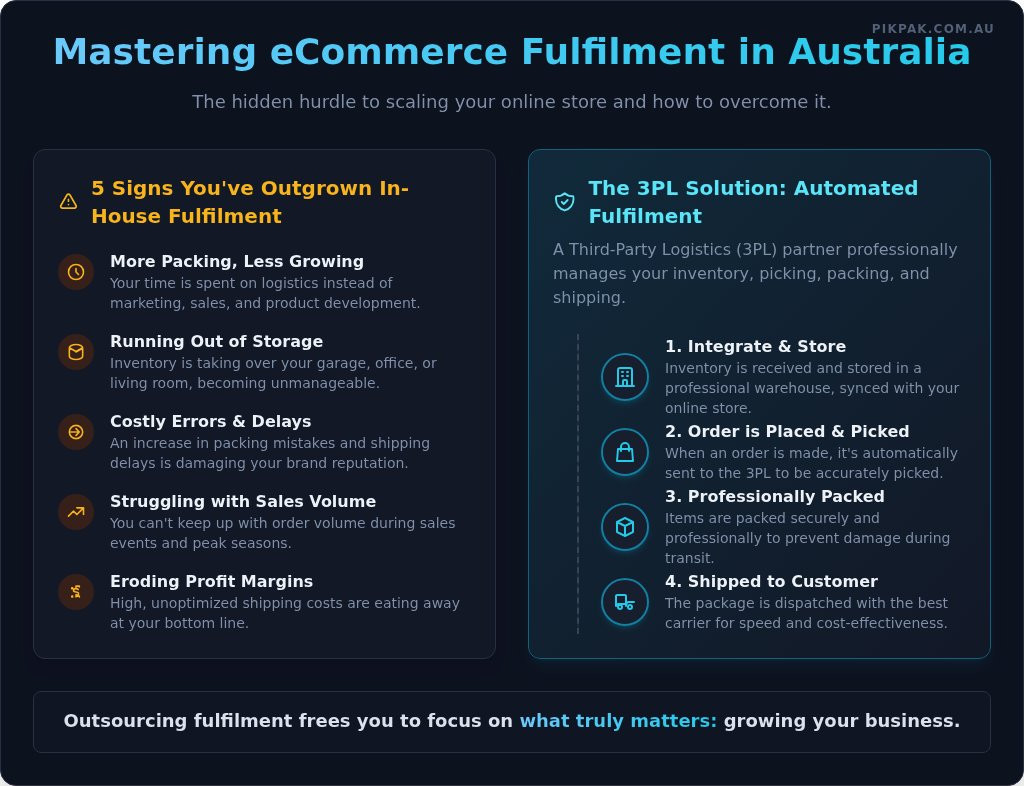
5 Signs You’ve Outgrown In-House Fulfilment
How do you know it’s time to outsource? The signs are usually clear. If you find yourself spending more time packing boxes than on marketing, sales, and product development, you’ve hit a ceiling. Other red flags include running out of storage space, a noticeable increase in packing errors or shipping delays, struggling to keep up with order volume during sales periods, and realising that high shipping costs are eroding your profits. Each of these is a signal that your current process is holding your business back.
The Solution: Partnering with a 3PL Provider
A 3PL (Third-Party Logistics) company is a partner that manages your warehousing, picking, packing, and shipping for you. By integrating their systems with your online store, a 3PL provider can completely automate your order fulfilment process. When a customer places an order, it’s sent directly to the 3PL’s warehouse, where their expert team handles everything. This frees you up to focus on growth, knowing your logistics are in professional hands. See how Pik Pak makes logistics easy. Learn more.
How to Choose the Right 3PL Partner in Australia
Choosing a logistics partner is a major decision, and not all 3PLs offer the same level of service or technology. To find the right fit, you need to look beyond just a price list and evaluate the key factors that will directly impact your customer experience and your bottom line. The goal is to find a true partner who can help you scale efficiently, not just a service that ships boxes.
Technology & Integration
The foundation of a great 3PL partnership is technology. A critical question to ask is: does their Warehouse Management System (WMS) connect seamlessly with your eCommerce platform (like Shopify or WooCommerce)? This integration is what enables automated, error-free order processing. You should also demand real-time visibility of your inventory levels and the status of every order, giving you and your customers complete transparency from warehouse to doorstep.
Location & Shipping Network
In a country as large as Australia, warehouse location matters. A 3PL with facilities in strategic locations like Melbourne or Sydney can help you reduce shipping times and costs by storing your products closer to your customers. Furthermore, established 3PLs have strong relationships with multiple shipping carriers, giving you access to more competitive rates and delivery options than you could secure on your own. This flexibility is key to handling both domestic and international orders efficiently.
Pricing & Scalability
Look for a partner with a transparent and flexible pricing model. You should clearly understand the fees for storage (per pallet or bin), picking and packing (per item or per order), and shipping. A “pay as you go” model is ideal for growing businesses, as it allows your costs to scale directly with your order volume without requiring large upfront investments or locking you into long-term contracts with fixed overheads. Get a clear, simple quote. Contact Pik Pak today.
Frequently Asked Questions
What is the most popular eCommerce platform in Australia?
Shopify is an extremely popular choice for Australian businesses of all sizes due to its ease of use and extensive app ecosystem. WooCommerce (for WordPress) and BigCommerce are also widely used, each with its own set of strengths.
How much does it cost to start an online business in Australia?
Costs can vary dramatically. You can start for a few hundred dollars using a subscription platform and a simple theme, but costs increase with custom design, app subscriptions, marketing budgets, and initial inventory investment.
Do I need to register for GST when selling online in Australia?
You are required to register for GST once your business has a turnover of $75,000 or more in a 12-month period. It’s best to consult with an accountant for advice specific to your situation.
What is a 3PL and when do I need one?
A 3PL (Third-Party Logistics) provider handles your warehousing and order fulfilment. You typically need one when you can no longer manage order volume yourself, are running out of space, or want to focus your time on growing the business rather than packing boxes.
How can I reduce my shipping costs in Australia?
Partnering with a 3PL is one of the most effective ways, as they provide access to bulk shipping rates you can’t get on your own. Other methods include using lighter packaging and offering local pickup options.
Can a 3PL handle customer returns?
Yes, most full-service 3PLs manage reverse logistics. They can receive returned products, inspect them, and either return them to your inventory for resale or process them according to your instructions.
Successfully scaling an eCommerce business in Australia hinges on a robust and efficient logistics strategy. While setting up a beautiful online store is the first step, ensuring a flawless customer experience from checkout to delivery is what builds a lasting brand. By understanding when and how to transition your fulfilment to a professional partner, you can unlock your business’s true potential. Focus on your business, not boxes. Discover how Pik Pak can handle your logistics.