10 Critical Questions to Ask a Third Party Logistics Provider
Choosing a third party logistics provider? Ask these 10 critical questions to vet partners and ensure you find a reliable 3PL to help your eCommerce business.
3PL GUIDEECOMMERCE FULFILLMENT
Pik Pak Digital
12/25/20257 min read


Why Choosing the Right Third Party Logistics Provider is Crucial
A third party logistics (3PL) provider is far more than just a vendor who moves boxes; they are an extension of your business and a critical partner in your growth journey.
The right partner becomes your operational backbone, saving you significant time, money, and the daily headaches of warehousing and shipping. By outsourcing these complex tasks, you can focus on what you do best: marketing, product development, and customer engagement.
Conversely, the wrong partner can lead to lost inventory, delayed shipments, and poor communication, which directly damages your brand and erodes customer trust.
First, Know Your Own Business Needs
Before you can effectively evaluate a 3PL, you need a clear picture of your own operational requirements.
Take a moment to gather some key data points, as this will allow you to have a much more productive conversation with potential partners.
Start by assessing your average monthly order volume to understand your current scale. Then, count the number of unique products (SKUs) you stock, as this impacts storage complexity.
Finally, identify your key sales channels, such as your Shopify, WooCommerce, or other eCommerce platforms, as seamless integration is non-negotiable.
Top Questions to Ask About Services and Operations
Once you have your data, it's time to dig into how a potential 3PL provider actually runs their day-to-day operations.
These questions are designed to reveal their competence, efficiency, and suitability for an eCommerce business like yours. Focus on their core processes to ensure they can meet your customers' expectations.
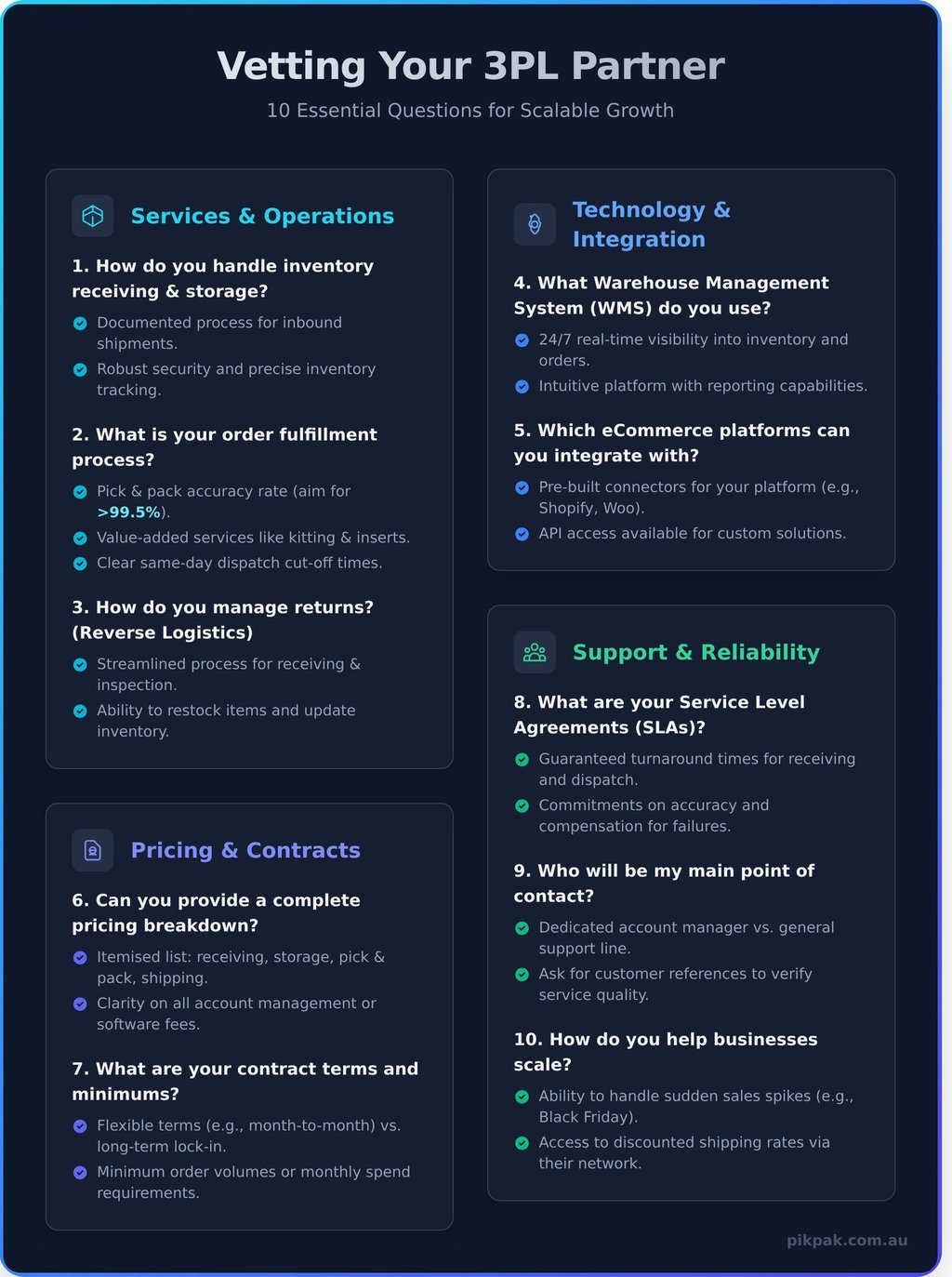
1. How do you handle inventory receiving and storage?
The process should begin the moment your stock arrives at their warehouse. Ask them to describe their standard procedure for inbound shipments, including how they check for accuracy and damage.
Inquire about the security measures in place to protect your products and what systems they use to maintain precise inventory counts.
A professional 3PL will have a clear, documented process for receiving, inspecting, and storing your goods safely and accurately.
2. Can you describe your order fulfillment process?
This is the heart of their service. Ask for their documented accuracy rate for picking and packing orders, anything less than 99.5% should be a red flag.
If your business requires it, find out if they offer value-added services like kitting (bundling multiple items into a single package) or inserting promotional materials.
Crucially, ask about their daily cut-off times for same-day dispatch to ensure your customers' orders go out as quickly as possible.
3. What is your process for managing returns (reverse logistics)?
Returns are an unavoidable part of eCommerce, and how they are handled can make or break customer loyalty.
A good 3PL should have a streamlined process for receiving returned items from your customers.
Ask if they can inspect products for damage, determine if they can be restocked, and update your inventory levels accordingly. This entire process should be transparent and visible to you through their software platform.
Critical Questions About Technology and Integration
In today's eCommerce landscape, technology is the backbone of any successful 3PL partnership.
Without a robust and reliable tech stack, you'll be left dealing with manual data entry, communication gaps, and costly errors.
Seamless integration between your store and their warehouse is essential for automating workflows and ensuring everything runs like clockwork.
4. What Warehouse Management System (WMS) do you use?
The WMS is the software that powers their entire operation.
Ask what level of real-time visibility you will have into your inventory and orders. You should be able to log in anytime, 24/7, to view current stock levels, track order statuses, and run reports.
The platform should be intuitive and easy to use, even for team members who aren't tech-savvy.
5. Which eCommerce platforms can you integrate with?
This is a deal-breaker. Confirm that the 3PL has a pre-built, proven connector for your specific eCommerce platform (e.g., Shopify, BigCommerce, WooCommerce).
Ask them to walk you through the setup process and confirm that they provide full support to get you connected.
For more complex needs, you can also inquire about API access for custom solutions, which provides greater flexibility as you grow.
Uncovering the True Cost: Questions About Pricing and Contracts
3PL pricing models can often be complex and filled with hidden fees if you're not careful.
The goal is to achieve complete clarity on all potential costs so you can accurately budget and avoid any unpleasant surprises down the line.
A transparent partner will be happy to break down their pricing for you.
6. Can you provide a complete breakdown of your pricing?
Don't accept a single, bundled price. Ask for a detailed, itemised list of all charges.
This should include separate line items for receiving inventory, monthly storage (often per pallet or bin), pick and pack fees (per order and per item), and the actual cost of shipping.
Also, be sure to ask about any recurring account management fees, software access fees, or additional costs for value-added services like kitting.
7. What are your contract terms and are there minimums?
Flexibility is key for a growing business. Ask if you are required to sign a long-term commitment or if they offer a more flexible, month-to-month agreement.
It's also vital to understand if there are minimum monthly order volumes or spending requirements you must meet.
Finally, discuss the process for scaling your usage up or down to ensure the partnership can adapt to your business's natural fluctuations.
Questions to Gauge Support and Reliability
When an order issue inevitably arises, the quality of your 3PL's customer support becomes paramount.
You need a partner who is responsive, accountable, and easy to work with.
These questions help you understand how they perform under pressure and who you can turn to for help.
8. What are your service level agreements (SLAs)?
An SLA is a formal commitment to a certain level of service.
Ask for their guaranteed turnaround times for receiving inbound stock and dispatching customer orders. What are their documented commitments on order and inventory accuracy?
Most importantly, find out how they take responsibility and compensate you if they fail to meet these agreed-upon standards.
9. Who will be my main point of contact?
Having a single, dedicated account manager who understands your business is far better than calling a generic support line. Ask if you will be assigned a main point of contact for all your queries.
Find out their standard support hours and what channels (phone, email, chat) are available.
Don't hesitate to ask for customer references you can speak with to get a firsthand account of their service quality.
10. How do you help businesses scale?
A true logistics partner should be invested in your growth.
Ask how their operations are designed to handle sudden sales spikes, such as during Black Friday or a successful marketing campaign.
Inquire if they can provide access to discounted shipping rates through their carrier network, which can significantly reduce your costs.
Finally, if you have global ambitions, ask if they can support your expansion into new markets.
Pik Pak: The Simple Answer to These Tough Questions
Finding a partner who can confidently and transparently answer these questions is the key to unlocking stress-free logistics.
At Pik Pak, we believe in making fulfillment easy and transparent for growing eCommerce brands. Our entire model is built on clear communication, powerful technology, and a pay-as-you-go structure with no lock-in contracts.
We give you the tools and support to focus on your business while we handle the hard work of getting your products to your customers' doors. See how our process works from start to finish.
Frequently Asked Questions
What's the difference between a 3PL and a freight forwarder?
A 3PL provider manages a wide range of logistics services, including warehousing, order fulfillment (pick, pack, ship), and returns management.
A freight forwarder, on the other hand, specializes specifically in arranging the transportation and shipment of goods from one point to another, but typically does not handle storage or order fulfillment.
How long does it take to onboard with a 3PL provider?
The onboarding timeline can vary but typically takes anywhere from a few days to a few weeks.
The process involves integrating your sales channels with their WMS, setting up your product information (SKUs), and sending your initial inventory to their warehouse.
A provider with pre-built integrations can significantly speed up this process.
Can a 3PL handle my custom packaging or branding needs?
Yes, many modern 3PLs, including Pik Pak, can accommodate custom packaging.
You can provide your own branded boxes, mailers, tape, or inserts, and they will use them when fulfilling your orders to ensure a consistent brand experience for your customers.
Is my inventory insured in a third party logistics warehouse?
Most reputable 3PLs carry their own comprehensive insurance policies for their facilities.
However, it's crucial to ask about the specifics of their coverage and confirm if you need to maintain your own separate insurance policy for your goods while they are in storage.
At what point should my business start using a 3PL provider?
A common trigger is when you're spending more time packing boxes than growing your business.
If you're running out of storage space, struggling to keep up with order volume, or want to offer faster, more competitive shipping, it's likely time to consider partnering with a 3PL.
Choosing the right third party logistics provider is a strategic move that can define your business's future success.
By asking these critical questions, you can cut through the sales pitches and find a partner who truly aligns with your needs.
At Pik Pak, we pride ourselves on our transparent, pay-as-you-go pricing with no lock-in contracts.
Our seamless integration with major eCommerce platforms and dedicated, Australian-based support are all designed to make your life easier. Ready to simplify your logistics? Get a quote from Pik Pak.
References
3PL Provider Selection Criteria—LinkedIn Supply Chain Management: 3PL Provider Evaluation Criteria
Choosing a 3PL Partner Questions—Flieber: 66 Questions to Choose the Right 3PL
Warehouse Management System Integration—Logiwa: Ecommerce WMS Integration Platform
Service Level Agreement Metrics—DCL Corp: What to Look for in 3PL Service Level Agreements
Order Accuracy Fulfillment Standards—Opensend: Perfect Order Rate Statistics for eCommerce
SKU Management Complexity—Cart.com: Guide to High SKU Counts in Fulfillment
Reverse Logistics Returns Management—GEODIS: Reverse Logistics and Returns Management Solutions
3PL vs Freight Forwarder Differences—Ship4wd: 3PL vs Freight Forwarder Comparison
3PL Pricing Models and Costs—GoBolt: 3PL Fees and Rates Guide
Customer Service in Logistics—Hiver: Customer Service in Logistics Strategies
Contact us
Useful Links
Established in 2007, Pik Pak specialises in warehousing and order fulfilment services designed specifically for online stores and eCommerce brands.
(c) 2025 All rights reserved.
Pik Pak Logistics Pty Ltd, ABN: 81 130 329 912
Our Partners